
Risk Management

If you manage a premises with a water system, from a small office block to a large industrial facility, you are legally obligated to manage the risk of Legionnaires’ disease.
This responsibility, whether you are the Duty Holder or the Responsible Person, falls under UK health and safety law, primarily the Control of Substances Hazardous to Health Regulations 2002 (COSHH).
Compliance isn’t a one-time fix; it’s a continuous cycle of management, monitoring, and review. Use this ultimate checklist to ensure your water safety regime is robust for 2026 and beyond.
Phase 1: Foundation and Risk Assessment 📋
The goal of this phase is to establish who is responsible and define the level of risk within your water system.
Appoint the Responsible Person: Assign a competent person (internal staff or external contractor) to oversee the entire Legionella control scheme. This person must be suitably trained and have the authority to implement control measures.
Conduct a Suitable and Sufficient Risk Assessment: Ensure a thorough assessment of all water systems is carried out by a competent assessor. This assessment must:
- Identify all water assets, including hot and cold-water services, cooling towers, and infrequently used outlets.
- Pinpoint conditions that favour Legionella growth (water temperatures between 20°c and 45°c stagnation, scale, and sludge).
- Be reviewed regularly or as required – two years is accepted and good practice, annually is recommended for high risk or complex systems, or immediately after any significant system change (e.g., refurbishment, change of building use, or staff change).
- Create a System Schematic: Develop an up-to-date schematic diagram of the entire water system, marking all assets, outlets, storage tanks, and critical control points.
Phase 2: The Written Scheme of Control ✍️
Once the risks are known, you must create a Written Scheme of Control. This is your actionable management plan.
Define Control Measures: Clearly document the steps required to control the risks identified in the assessment. This is typically achieved by maintaining water temperatures outside the danger zone:
- Hot Water: Stored at 60°c and distributed at 50°c within one minute at the outlet (or 55°c in healthcare settings).
- Cold Water: Distributed and stored below 20°c
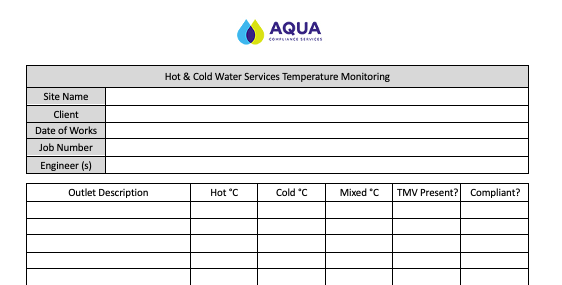
- See our previous blog for more information on temperature monitoring Temperature Monitoring
Establish Monitoring Procedures: Detail the exact schedule and methodology for all routine checks (e.g., weekly flushing, monthly temperature monitoring, quarterly shower cleaning, six-monthly tank inspections).
Outline Remedial Actions: Include a clear, step-by-step procedure for what to do if control limits are breached (e.g., if cold water is found above 20°cor if a Legionella sample returns positive).
Specify Training Requirements: Mandate that the Responsible Person, their deputies, and all personnel involved in monitoring receive appropriate and documented Legionella awareness training.
Phase 3: Implementation, Monitoring, and Auditing 📈
This is the phase of continuous diligence the daily, weekly, and monthly tasks that prove your system is under control.
| Task | Frequency (Minimum) | Compliance Focus |
| Outlets Flushed | Weekly | Flush little-used taps and showers for 2 minutes to prevent stagnation. |
| Hot/Cold Temperatures | Monthly | Check sentinel and representative points to prove temperature control. |
| Calorifier Checks | Monthly | Check and record flow and return temperatures to confirm hot water generation and circulation. |
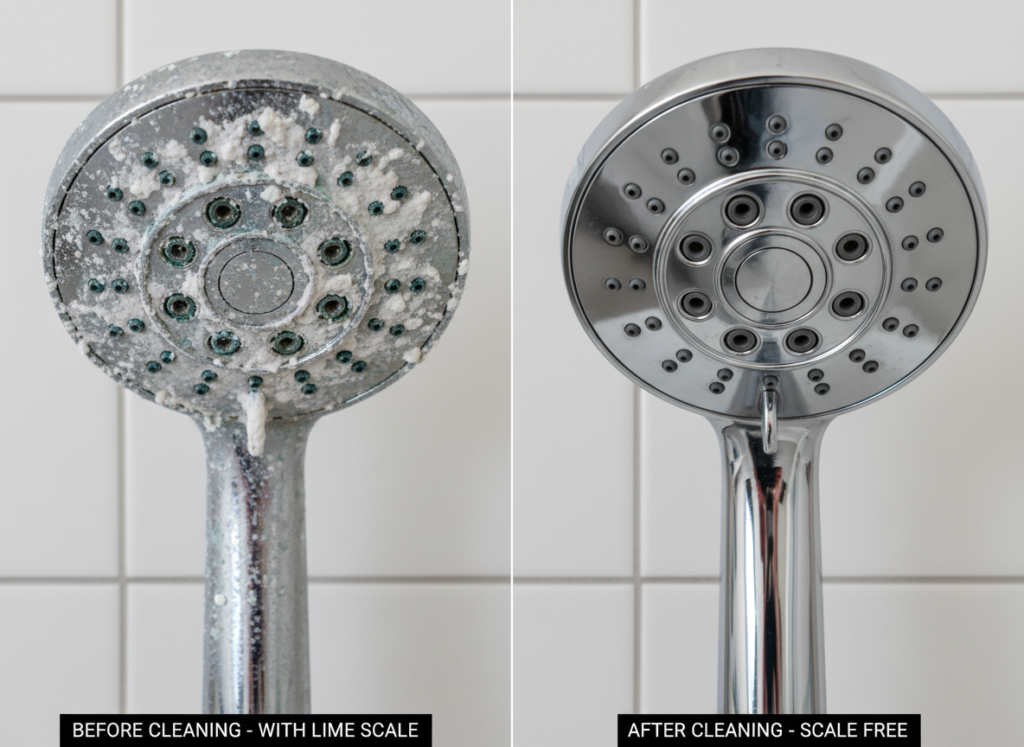
| Showerhead Cleaning | Quarterly | Dismantle, clean, and descale all showerheads and hoses. |
| Cold Water Tank Inspection | Six-Monthly | Visually inspect tanks for contamination, debris, corrosion, and lid integrity. |
| Legionella Sampling | As per Risk Assessment | Necessary for high-risk systems (e.g., cooling towers) or following a breach in control. |
Phase 4: Documentation and Review 📂
Compliance relies on proof. If it’s not written down, it didn’t happen.
Maintain Records: Keep detailed records of all monitoring checks, maintenance activities, remedial works, and training certifications.
Review and Validate: Regularly review the Written Scheme of Control and its effectiveness. If any part of the system is modified, if there is a change in the use of the building, or if a case of Legionnaires’ disease is suspected, the entire risk assessment and control scheme must be immediately reviewed and updated.
Failure to follow this cycle is not just poor practice; it is a breach of duty that can lead to unlimited fines and potential criminal prosecution under the Health and Safety at Work Act.
Partner with a competent water treatment company to manage and maintain your checklist, ensuring your premises are safe and compliant year after year.
Check out our other blogs for more helpful advice on Legionella Control https://aquacompliance.co.uk/blog/
Discover the Latest Blogs
Stay informed with our informative blog posts and articles.
All blogs
How to Read a Water Hygiene Report
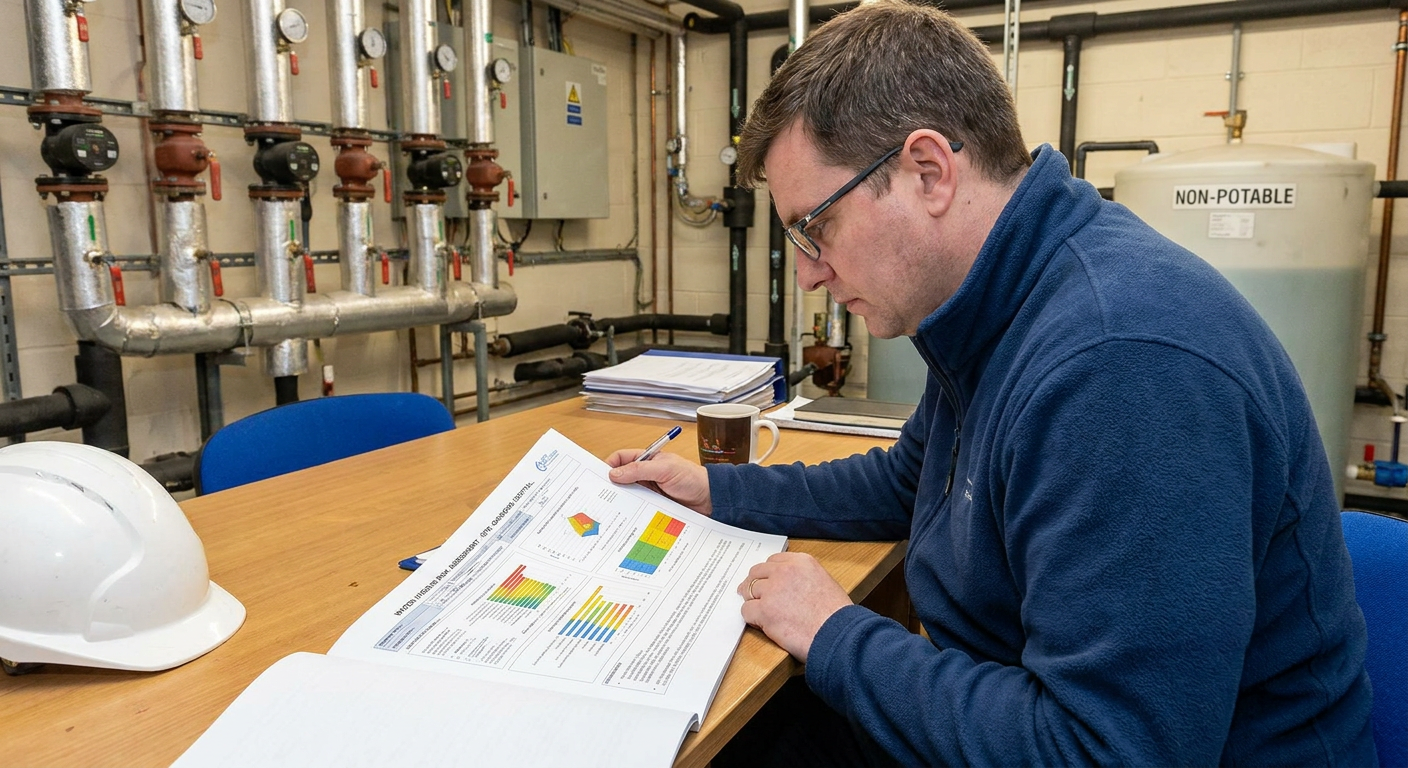
A water hygiene report should not just be filed away. It should help you understand what is happening across your water systems, what risks exist, and what actions need to be taken. HSE’s ACOP L8 is aimed at dutyholders and covers identifying and assessing risk, preparing a scheme to prevent or control risk, implementing and monitoring precautions, keeping records, and
Why Compliance Should Be Proactive, Not Reactive
In water hygiene and Legionella compliance, timing is everything. Too often, action is taken after something goes wrong – a failed audit, a temperature issue, or a gap in records. But by then, the risk has already existed for some time. The difference between reactive and proactive compliance is simple: Reactive compliance manages problems.Proactive compliance prevents them. And in complex

The Top 5 Water Hygiene Risks in Commercial Buildings
When it comes to Legionella compliance, the biggest risks aren’t always the obvious ones. In fact, most issues we see come from small, everyday gaps that go unnoticed over time. Understanding these risks is the first step to controlling them. 1. Inconsistent Temperature Control Hot and cold water systems depend on maintaining the correct temperatures. When checks are missed or